I published an article about using Telegram forum topics for multi-mode AI assistants in the last couple of days. One bot, multiple agents, isolated contexts. It was working well.
Then a friend asked a simple question.
The Question
Yasin asked: "Why Telegram and not Slack?"
My immediate reaction was to defend the choice. Slack feels cluttered. Telegram feels cleaner, more conversational. I use Slack for work, and I wanted something separate for journaling and writing. Slack = corporate. Telegram = personal.
Honestly, I think I conflated Slack with Notion in my head. Notion feels slow and clunky to me, and somehow I'd put Slack in the same category. They both felt like tools I didn't want to use.
The Story I Told Myself
Here's what I said about Slack: - Less UI friction in Telegram - Slack feels overwhelming - I need work/play separation - Telegram topics feel more structured
Here's what I didn't say: - My previous Slack workflow was a mess - Lots of old channels, failed experiments, accumulated clutter - Mental friction from past failures, not the platform itself
I was carrying forward a story from a previous failed attempt and framing it as "this doesn't work for me."
What Actually Happened
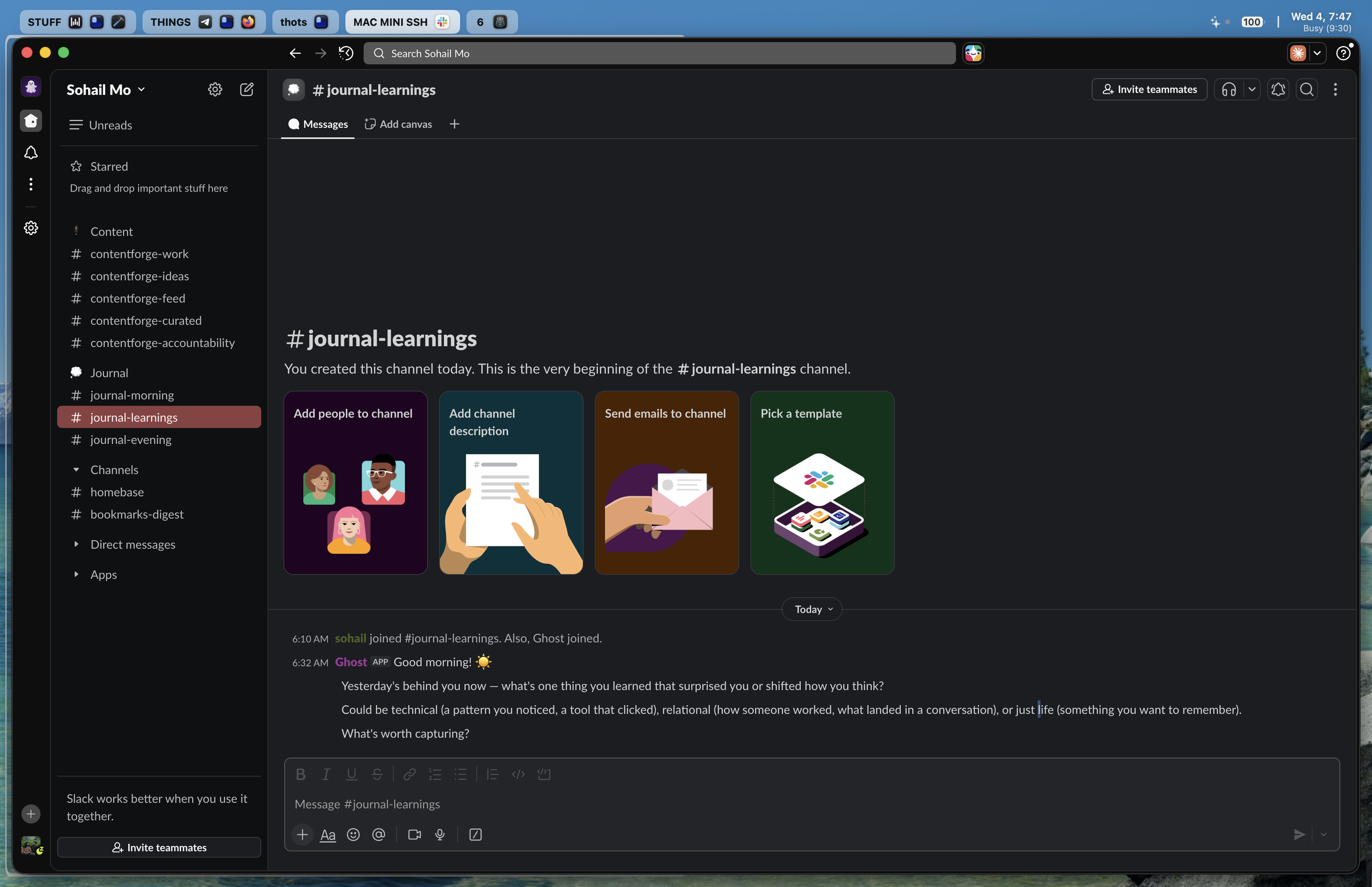
This morning I switched. Cleaned up old channels. Changed the theme to something that felt cleaner, more like a fresh start. Reconfigured the setup.
Took less than an hour.
It felt fluid immediately. Better UI for what I was doing. Easier to compartmentalize. Threads, search, table rendering, basically all the things I'd ignored because I was stuck in the old story.
The shift was awesome.
The realization hit: the problem wasn't Slack. The problem was accumulated mess from old attempts. I'd been avoiding the tool when what I really needed was to clean up the clutter first.
The Broader Pattern
I think there's a broader pattern here, especially when working with LLMs.
When you're in a conversation with Claude Code or Codex or whatever, it's really easy to rush into the next decision. You're excited. You want to try the thing. You're already in this specific environment, so you just keep iterating there.
It's not an intentional system design choice. It's a byproduct of momentum and excitement.
I did that here. I was already in Telegram, already building, so I just kept going. I didn't objectively evaluate whether Slack would actually be better. I just defended the choice I'd already made based on past baggage.
The cost: I missed nuances. I didn't assess the tools on current conditions. I made a decision based on past emotions instead of trying to figure out what was really blocking me.
Where Else Am I Doing This?
This is the question that matters.
If this is a pattern, where else is it showing up?
Tools I've dismissed based on old failed attempts? Workflows I avoid because they "didn't work" last time, but really I just didn't set them up right?
Making decisions based on past emotions instead of current evidence kills momentum.
The Lesson
Check your assumptions. Past failure doesn't equal current conditions.
The blocker wasn't Slack. It was old clutter I hadn't cleaned up yet. Once I cleared it, the tool worked great.
If something feels like a blocker, ask: is this actually a problem with the tool, or am I carrying forward a story from a previous failed attempt?
Sometimes the thing you're avoiding is just the thing that needs cleaning up first.